The Cultural Power of Paying Attention
Miriam Baker
August 28, 2026
Attention has become one of the most contested resources in modern life. Every notification, headline, advertisement, video, platform, and recommendation is asking for a piece of it. We move through more information in a single day than we could meaningfully absorb, which means much of what we encounter receives only a few seconds before something else replaces it. In that environment, paying attention can seem almost passive. It is not. What we choose to notice influences what succeeds, what gets remembered, what becomes culturally important, and eventually what gets made. Attention is not simply something we have. It is something we give, and collectively, those choices have enormous power.
What we notice becomes culturally important
Culture does not become significant only because something is objectively good. It becomes significant because enough people give it attention. A song moves from obscurity into everyday life because people listen, share, discuss, imitate, and return to it. A book becomes part of a cultural conversation because readers recommend it to one another. A fashion trend can move from a small community to the mainstream because enough eyes land on it at the right moment. Attention creates momentum. This has always been true, but digital platforms have made the process faster and more visible. Views, streams, likes, searches, and shares now provide measurable evidence of what people are noticing, and those signals can influence what receives even more exposure.
Algorithms shape what gets our attention
We like to imagine that our interests are entirely our own, but much of what we encounter is selected before we consciously choose it. Recommendation systems decide which video appears next, which post reaches the top of a feed, which song follows the one we selected, and which headline is placed in front of us. These systems can be incredibly useful. They help us discover artists, writers, ideas, and communities we might never have found otherwise. But they can also create a feedback loop. We pay attention to what is shown to us, and what we pay attention to teaches the system what to show us next. Over time, this can make the world feel narrower than it really is. Paying attention intentionally sometimes means stepping outside that loop and looking for things that were not automatically placed in front of us.
Paying attention keeps small things alive
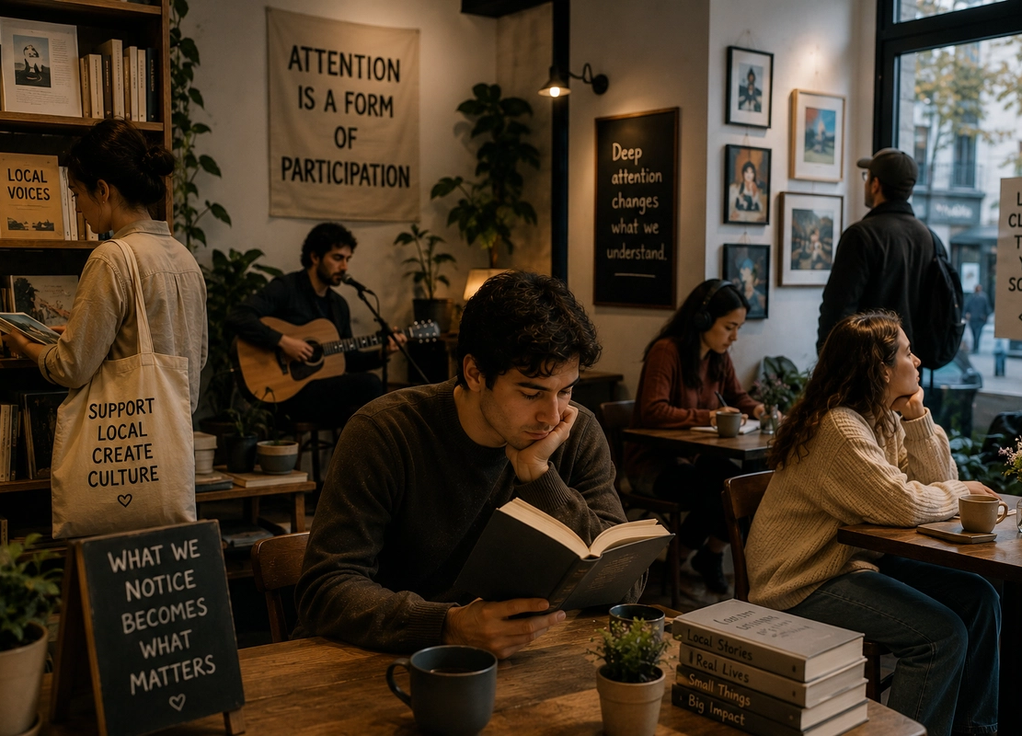
Attention does not only determine which global trends dominate the internet. It can also decide whether smaller cultural traditions survive. Independent bookstores, local newspapers, neighborhood restaurants, regional music, traditional crafts, small cinemas, local languages, and community events all depend in some way on people continuing to care about them. When attention disappears, money and participation often follow. Choosing to visit the local shop instead of automatically ordering online or attending a small exhibition instead of only consuming whatever is trending may seem insignificant. Individually, perhaps it is. Collectively, those choices determine which parts of culture remain economically and socially possible. Preservation is not only the work of institutions. It also happens through ordinary people deciding that something is worth noticing.
Deep attention changes what we understand
There is a difference between seeing something and paying attention to it. You can walk through a museum in an hour and technically see hundreds of works without really looking at any of them. You can finish a book while repeatedly checking your phone and remember very little afterward. You can travel somewhere and spend so much time documenting it that you barely notice the details around you. Deep attention slows the experience down. It allows complexity to appear. A film that initially seems boring may become fascinating when you stop expecting constant stimulation. A difficult book can reveal itself after fifty pages rather than five. A conversation becomes more interesting when you listen instead of waiting for your turn to speak. Attention gives things enough time to become more than their first impression.
Attention is a form of participation
Every time we watch, click, buy, recommend, subscribe, or share, we participate in deciding what receives more space. This does not mean every entertainment choice needs to become a moral decision. Sometimes you should watch the ridiculous video simply because it makes you laugh. But it is worth remembering that attention has consequences. If we constantly reward outrage, we should not be surprised when more outrage is produced. If thoughtful work receives no attention because it takes longer to consume, less of it may eventually be made. Creators respond to audiences, platforms respond to engagement, and businesses respond to demand. What we choose to spend time with sends a signal, even when we never intended to send one.
Protecting your attention is also protecting your life
The cultural power of attention eventually becomes personal. What repeatedly receives your attention begins to shape how your days feel and what occupies your thoughts. Spend hours around anger and everything can begin to look hostile. Spend all your time watching other people’s lives and your own may start to feel strangely insufficient. Give sustained attention to books, music, people, places, and ideas you care about, and they become a larger part of your internal world.
We cannot pay attention to everything, and that is exactly why attention matters. Choosing one thing always means temporarily ignoring thousands of others. In an environment designed to constantly redirect our focus, deciding what deserves more than a few seconds is increasingly meaningful. Culture is shaped not only by the people who create things but also by the people who choose to stop, look, listen, read, and care. Paying attention may feel like a small private act. Collectively, it decides what the world keeps making room for.