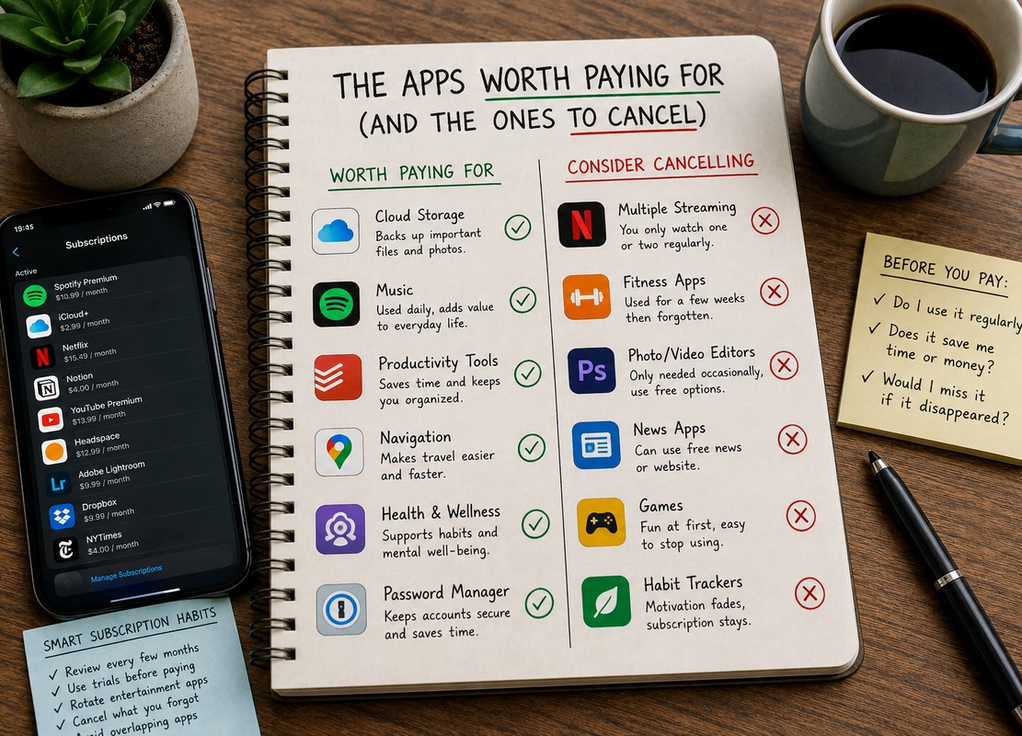
The Apps Worth Paying For (And the Ones to Cancel)
Miriam Baker
August 28, 2026
Paying a few euros a month for an app rarely feels significant. That is exactly why subscriptions accumulate so easily. A streaming service here, cloud storage there, a fitness app you used enthusiastically for three weeks, a photo editor you forgot was still renewing, and suddenly a collection of individually inexpensive subscriptions has become a meaningful monthly expense. The answer is not to cancel everything. Some apps genuinely save time, improve everyday life, or provide enough entertainment to justify their cost many times over. The useful question is not whether an app is cheap. It is whether you would notice if it disappeared.
Pay for apps that solve a recurring problem
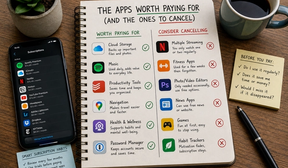
The easiest subscriptions to justify are the ones that repeatedly remove friction from your life. If you use a password manager every day, depend on cloud storage for important files, or rely on a particular productivity tool for work, the value is easy to see. The same can apply to navigation, language learning, budgeting, meditation, fitness, or other categories depending on your routine. Frequency matters. An app that saves you ten minutes several times a week may be more valuable than an impressive service you open twice a year. Before renewing, ask what specific problem the app solves and how often that problem appears. If you struggle to answer, the subscription may be surviving through habit rather than usefulness.
Keep entertainment subscriptions you actually use
Streaming subscriptions are easy to accumulate because each platform has something you might eventually want to watch. But paying for five services simultaneously does not create five times as much free time. Keep the platforms you are actively using and rotate the rest. If there is a series you want to watch somewhere else, subscribe for a month, watch it, and cancel afterward. The same approach works for music, audiobooks, gaming, digital magazines, and other entertainment services. Paying for entertainment is not wasteful if you genuinely enjoy it. In fact, a service used for hours every week can offer excellent value. The problem is paying indefinitely for the possibility that you might use something later.
Be suspicious of apps that charge for motivation
Fitness, productivity, meditation, habit tracking, and self-improvement apps can be genuinely useful, but they also benefit from our optimism about the person we plan to become. You download the app when motivation is high, choose an annual subscription because it offers a discount, and then stop opening it six weeks later. Before paying, use the free version or trial long enough to see whether the behavior actually fits your life. An annual plan is only cheaper if you continue using the service. If the main value of an app is that paying for it makes you feel more committed to a goal, consider whether a simpler or free alternative would produce the same result.
Pay when the free version wastes your time
Sometimes paying for an app is worthwhile precisely because the free version is annoying. Ads, restrictive limits, repeated interruptions, limited storage, or missing features can create enough friction that a modest subscription significantly improves something you use constantly. If you open an app every day, removing advertisements or unlocking a useful feature may be worth far more than the monthly price. The calculation changes for something you use occasionally. Paying to remove an inconvenience you experience twice a month probably offers less value. Consider cost per use rather than cost per month. A €10 subscription used every day costs roughly a few cents each time. The same subscription opened once that month costs €10 per use.
Cancel subscriptions you forgot you had
The clearest sign that an app is not worth paying for is discovering the charge and briefly wondering what it is. Review your subscriptions every few months through your phone’s app store, bank statements, email receipts, and services billed directly through websites. Look especially for free trials that converted into paid plans and annual subscriptions, which are easier to forget because the charge appears only once a year. Do not keep something simply because you have already paid for several months. Past spending is gone whether you continue subscribing or not. If you have not used an app recently and cannot identify when you realistically will, cancel it. Most services will happily allow you to return later.
Avoid paying for several apps that do the same thing
Subscription overlap is another quiet source of wasted money. You may have several cloud-storage services, multiple note-taking tools, two fitness apps, or overlapping entertainment platforms. Individually, each service may be useful, but together they can become unnecessary. Choose the one that fits your needs best and simplify. This has benefits beyond saving money. Fewer apps mean fewer places where files, notes, photos, tasks, and information can disappear. Consolidation can make your digital life easier to manage while reducing recurring costs.
The apps worth paying for are not necessarily the most sophisticated or popular. They are the ones that repeatedly earn their place in your life. Keep the service that stores your important files, the music app you use every day, the tool that saves hours of work, or the entertainment platform your household genuinely enjoys. Cancel the subscription that exists mainly because cancelling takes effort. A good digital subscription should make you think, “I would miss this.” If your reaction is closer to “I forgot I was paying for that,” you probably already have your answer.