
How to Spend Less Time Online Without Going Off-Grid
Camilo Park
August 28, 2026
Spending less time online sounds simple until you remember how much of ordinary life now happens there. Work arrives through email, friends communicate through messages, maps tell us where to go, banking happens through apps, and entertainment is available whenever we want it. Completely disconnecting is unrealistic for most people, and it is not necessarily desirable. The problem is not being online. It is reaching for the internet automatically, filling every quiet moment with a screen, and realizing at the end of the day that hours disappeared without you consciously choosing how to spend them. The goal does not need to be going off-grid. It can simply be making the internet something you use deliberately instead of somewhere you constantly live.
Find out where your time is actually going
Before trying to reduce screen time, look at what is consuming it. Most phones and computers can show how much time you spend in individual apps, and the results can be surprising. You may think work email is responsible for most of your screen time only to discover that short visits to social media quietly add up to hours each week. Pay attention to when the scrolling happens too. Maybe you reach for your phone immediately after waking, while watching television, during meals, whenever work becomes difficult, or every time you have thirty seconds with nothing to do. Understanding the pattern is more useful than setting an arbitrary goal such as cutting screen time in half. You need to know what you are trying to change before deciding how to change it.
Make distracting apps slightly harder to reach
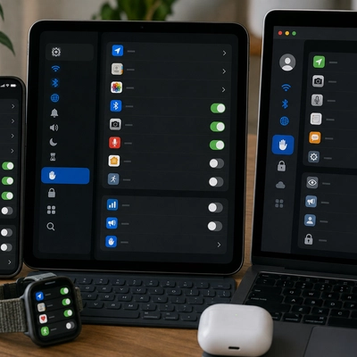
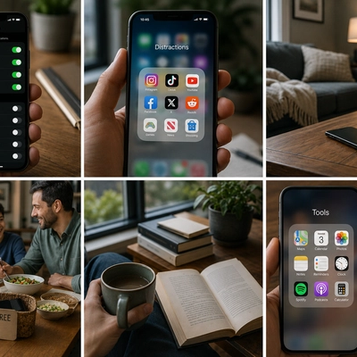
You do not necessarily need to delete every social platform from your phone. Start by adding a little friction. Remove distracting apps from the home screen, turn off nonessential notifications, log out after using certain services, or access them through a browser instead of an app. Even a few extra seconds between impulse and action can interrupt automatic behavior. Notifications deserve particular attention because they allow other people and companies to decide when you look at your phone. Keep alerts that genuinely require timely attention and silence the rest. Most likes, news updates, shopping offers, and app reminders can wait until you choose to open them. Your phone becomes considerably quieter when every application is no longer allowed to announce itself whenever it wants your attention.
Create parts of the day that stay offline
Instead of trying to spend less time online everywhere, choose a few situations where being offline becomes the default. The first thirty minutes after waking might be one. Meals could be another. Maybe phones stay away during walks, while watching a film, or for the final hour before bed. Clear boundaries are often easier to follow than repeatedly asking yourself whether you have been online too much today. They also allow you to experience familiar activities differently. Breakfast feels longer when it does not happen beside a feed. A walk becomes more noticeable when you are not checking messages. A conversation changes when neither person keeps glancing toward a screen. These periods do not need to be long to create a sense that your entire day is not happening through a device.
Replace scrolling with something specific
Simply removing screen time creates an empty space, and empty spaces have a tendency to refill themselves. Decide what you would rather do instead. Keep a book somewhere visible. Leave a magazine near the sofa. Go for a short walk, make coffee, listen to music, cook, stretch, call someone, or work on a hobby that uses your hands. The replacement does not need to be productive. Watching a film intentionally for two hours can feel very different from spending two hours moving between apps without remembering much of what you saw. The important distinction is choosing the activity. If your only plan is “use my phone less,” your phone remains the easiest available source of stimulation whenever boredom appears.
Stop filling every tiny pause
Waiting has almost disappeared from everyday life. We check our phones in elevators, supermarket lines, waiting rooms, traffic, and the thirty seconds before someone else arrives. None of these individual moments seems important, but together they train us to expect constant stimulation. Try occasionally leaving the phone alone. Look around while waiting for coffee. Sit on public transportation without immediately opening something. Stand in line and allow yourself to be bored. These moments give the mind a chance to wander, notice, remember, and process things without new information constantly arriving. At first, doing nothing can feel surprisingly uncomfortable. That discomfort is useful because it reveals how automatic the habit of reaching for a screen has become.
Use the internet as a tool instead of a default
One of the easiest ways to spend less time online is to enter with a purpose. Before opening an app or browser, know what you are there to do. Reply to the message, check the directions, read the article, buy the ticket, or look up the information you need. Then leave. This sounds almost absurdly simple, but it creates a clear distinction between using the internet and wandering through it. You can still deliberately spend an hour watching videos or scrolling if that is genuinely how you want to relax. The difference is that you chose it.
Spending less time online does not require deleting every account, buying a basic phone, or disappearing for a digital detox weekend. Small boundaries can change the relationship much more sustainably. Turn off unnecessary notifications, protect a few offline periods, keep alternatives nearby, and allow some empty moments to remain empty. The internet is extraordinarily useful, entertaining, and often necessary. It simply becomes better when you can close it without immediately wondering what you are missing.