How to Stop Procrastinating (Backed by Psychology)
Dion Barajas
August 28, 2026
Procrastination is often treated as a time-management problem. You know what needs to be done, you have enough time to do it, and yet you find yourself answering messages, reorganizing files, cleaning the kitchen, or doing almost anything except the task that matters. Psychology suggests the problem is more complicated than simply being lazy or undisciplined. Procrastination is often connected to emotion regulation: when a task creates boredom, anxiety, frustration, uncertainty, or self-doubt, avoiding it can provide immediate relief. The problem is that short-term relief creates long-term stress. Breaking that cycle requires making difficult tasks easier to begin, reducing the emotions attached to them, and designing your environment so avoidance is less convenient.
Make the first step ridiculously small
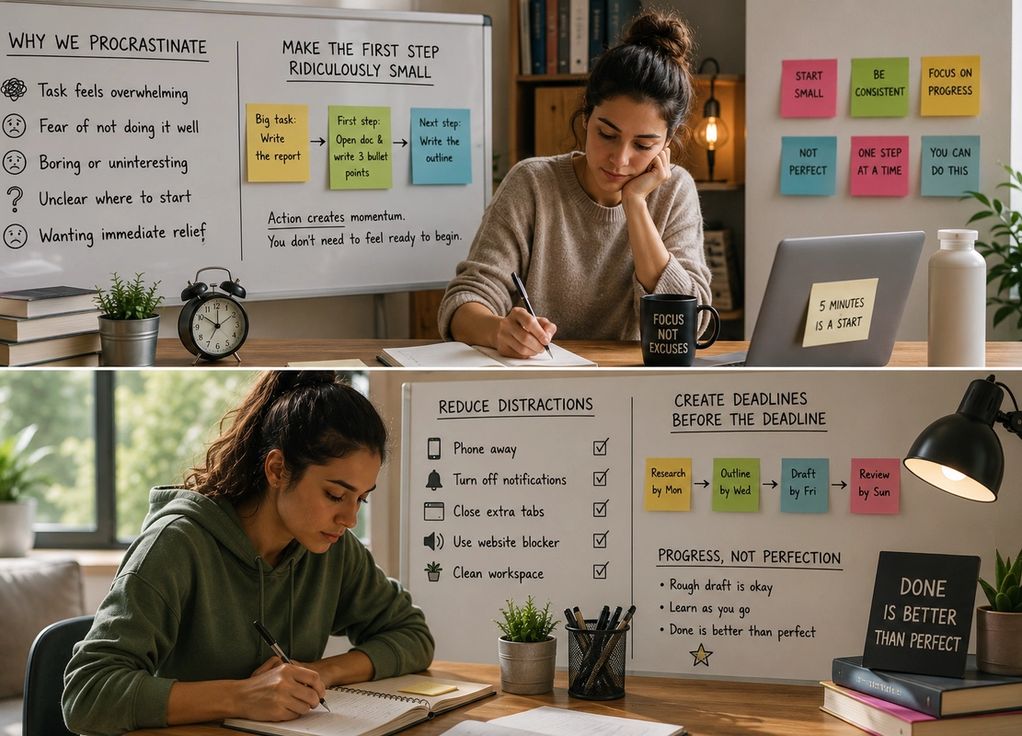
One reason people procrastinate is that they think about the entire task at once. “Write the report” feels large and undefined. “Open the document and write three bullet points” feels manageable. Breaking work into concrete actions reduces the psychological barrier to starting. This also takes advantage of a simple truth about motivation: you do not always need to feel motivated before you begin. Action itself can create momentum. Tell yourself you only need to work for five or ten minutes. Once you have started, continuing often feels easier because the task is no longer abstract. Even if you stop after those ten minutes, you have still weakened the association between the task and avoidance. The next starting point is now closer than it was before.
Identify what you are actually avoiding
When you notice yourself procrastinating, ask what feels uncomfortable about the task. Sometimes it is boring. Sometimes you do not know where to begin. Sometimes you are afraid the result will not be good enough. A task may also feel overwhelming because it contains several decisions you have not made yet. Different problems require different solutions. If the task is unclear, define the next action. If it feels too large, divide it into smaller pieces. If perfectionism is getting in the way, deliberately create a rough first version. If boredom is the issue, use a timer or combine the task with something pleasant, such as working somewhere you enjoy. Procrastination becomes easier to address when you stop treating it as one universal problem and identify the specific feeling you are trying to escape.
Remove the easiest distractions
Willpower is much less reliable than environment. If your phone is beside you, notifications are appearing on your screen, and ten browser tabs are competing for attention, staying focused requires repeated acts of self-control. Make distraction slightly harder instead. Put your phone in another room, silence unnecessary notifications, close unrelated tabs, or use a website blocker during focused work. At the same time, make the task itself easier to access. Leave the document open, place the materials you need on your desk, or prepare your workspace before taking a break. These changes may seem minor, but behavior is strongly influenced by convenience. When distraction requires several steps and productive work requires one, you have changed the odds in your favor without relying entirely on discipline.
Use deadlines before the real deadline
A distant deadline gives procrastination plenty of room to operate. If something is due in three weeks, there is little immediate consequence for ignoring it today. Create smaller deadlines along the way. Decide when the research should be finished, when the first draft should exist, and when you will revise it. These intermediate deadlines work particularly well when they involve some external accountability. Tell a colleague when you will send a draft, schedule a meeting to review progress, or work alongside someone else who is also trying to finish something. The goal is not to create constant pressure. It is to make progress visible before the final moment. A project completed in several imperfect stages is much easier to manage than one enormous task waiting for a last-minute burst of panic.
Stop waiting to feel ready
Procrastination often hides behind reasonable-sounding conditions. You will begin when you have more energy, when you have uninterrupted time, when inspiration arrives, or when you understand the task perfectly. Unfortunately, the ideal moment may never appear. Productive people are not always more motivated; they are often simply more willing to begin while feeling unmotivated. Give yourself permission to produce a bad first attempt. Write the awkward opening paragraph. Do an imperfect twenty-minute workout. Make the rough outline. Progress creates information, and information makes the next step easier. Perfectionism does the opposite: it makes starting feel dangerous because anything you produce can be judged against an unrealistic standard.
Respond to procrastination with curiosity, not punishment
Beating yourself up for procrastinating can create exactly the emotions that encourage more avoidance. You lose an afternoon, feel guilty about losing it, and then the task becomes associated with even more stress. Instead, look at what happened practically. Were you tired? Was the task unclear? Did you underestimate how long it would take? Were distractions too accessible? Use the answer to change your approach next time. This does not mean pretending missed deadlines do not matter. It means treating procrastination as a behavior you can understand rather than evidence that something is wrong with your character.
Stopping procrastination is rarely about discovering enough discipline to suddenly enjoy every difficult task. It is about making starting easier and avoidance harder. Shrink the first step, understand what you are resisting, remove obvious distractions, create earlier deadlines, and begin before you feel completely ready. You may still procrastinate sometimes; almost everyone does. But the goal is not perfect productivity. It is learning how to shorten the distance between knowing something needs to be done and actually beginning it.