How to Pack Light Without Sacrificing Anything
Dion Barajas
August 27, 2026
Packing light sounds great until you actually have to decide what stays behind. Suddenly, every extra shirt feels necessary, three pairs of shoes seem completely reasonable, and you start imagining highly specific situations that require an outfit you have not worn in two years.
But packing light does not have to mean traveling with the bare minimum. The goal is not to fit your entire trip into the smallest bag possible. It is to bring everything you will realistically need without carrying a suitcase full of things you never use.
The best light packers are not necessarily minimalists. They are simply better at choosing items that work harder.
Start with the trip, not your wardrobe
One of the easiest ways to overpack is to open your closet and start choosing things you like. Instead, think through the trip first.
What will an average day actually look like? Will you spend most of your time walking around a city, sitting on a beach, hiking, going to restaurants, or moving between different places? How many occasions genuinely require something different from your everyday clothes?
Once you know what you will actually be doing, packing becomes much easier.
Instead of preparing for every possible scenario, prepare for the most likely ones. You probably do not need three elegant outfits because you might go somewhere fancy. One versatile option is usually enough.
Weather matters too, but avoid packing for every temperature imaginable. Check the forecast shortly before leaving and build around the conditions you are most likely to encounter.
Build outfits that share the same pieces
Packing individual outfits can quickly fill a suitcase. A better approach is to create a small group of clothes that can be mixed together.
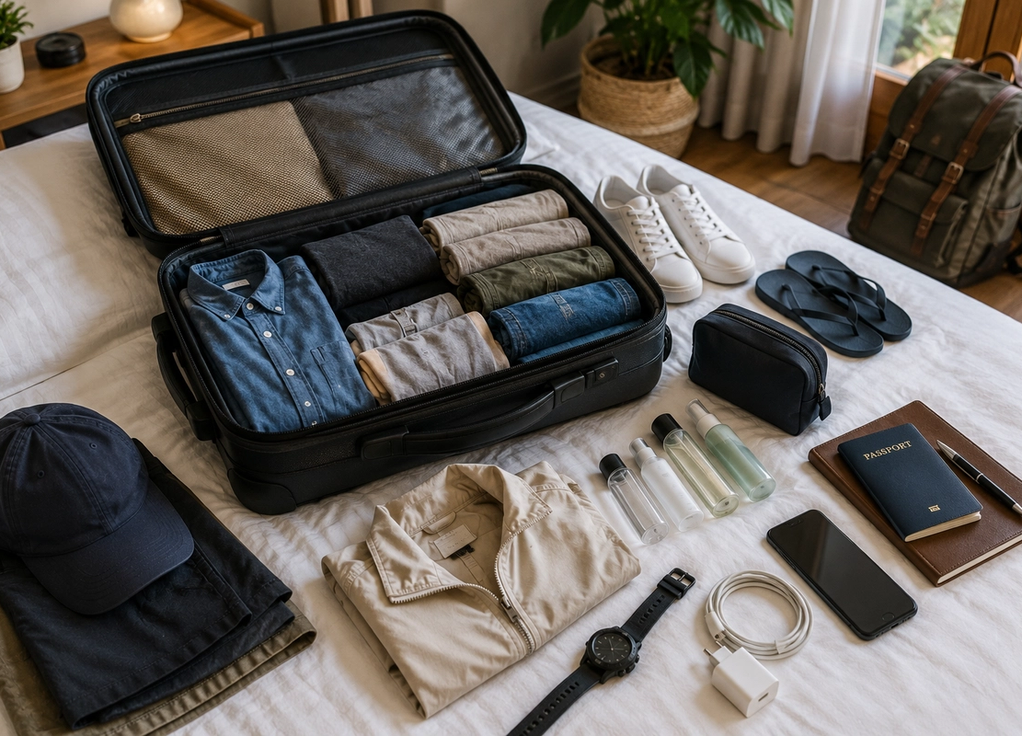
Choose bottoms that work with several tops. Bring layers that can be worn over almost anything. Keep most of your clothes within a loose color palette so you do not end up with pieces that only work once.
A pair of trousers might work for sightseeing during the day and dinner at night. A button-down shirt can be worn normally, layered over a T-shirt, or used as a light cover-up. A simple dress can work with sneakers during the day and look completely different with nicer shoes in the evening.
This is where packing light stops feeling restrictive. You are not necessarily bringing fewer outfits. You are bringing fewer individual pieces while creating more combinations.
Be ruthless about shoes
Shoes are often responsible for turning a reasonable suitcase into an overpacked one. They are bulky, heavy, and difficult to squeeze into unused spaces.
For most trips, two or three pairs are enough.
One should be comfortable enough for the activity you will do most. The second can cover situations where your everyday shoes do not work, such as a nicer dinner, beach day, or hike. A third pair only earns its place if the trip genuinely requires it.
Wear the bulkiest pair while traveling rather than packing it.
The same rule applies to jackets, boots, and other heavy pieces. If you know you will need them, let them become part of your travel outfit instead of taking up half your luggage.
Pack smaller versions of everyday essentials
Packing light becomes much easier when you stop treating your suitcase like your bathroom cabinet.
You probably do not need full-size bottles of shampoo, conditioner, moisturizer, cleanser, sunscreen, and every other product you use at home. Transfer what you need into smaller containers or bring travel-size versions.
The same goes for technology. Before packing several chargers, adapters, cables, cameras, tablets, and other devices, ask which ones you will genuinely use.
Try to eliminate duplicates wherever possible. If two devices can use the same charger, bring one. If your phone takes perfectly good photos for the kind of trip you are taking, think carefully before adding a heavy camera.
Small reductions across several categories can save a surprising amount of space.
Leave some empty space on purpose
A perfectly packed suitcase with no room left might feel efficient on departure day, but it becomes annoying almost immediately.
Clothes rarely fold as neatly once you are traveling. You may buy something. You might need to pack quickly before checking out. Suddenly, the suitcase that closed easily at home requires you to sit on it.
Leaving a little empty space makes the entire trip easier.
It also gives you flexibility. You can bring home a souvenir without worrying about baggage limits, throw a sweater into your suitcase when the weather gets warmer, or pack without recreating an elaborate folding system every morning.
Empty space is not wasted space. It is part of good packing.
Pack for comfort, not imaginary situations
Most overpacking comes from “just in case” thinking.
What if there is an unexpected formal dinner? What if you suddenly decide to exercise every morning? What if the temperature drops dramatically? What if you need four different evening outfits?
Some preparation makes sense. Preparing for every unlikely possibility does not.
In most destinations, forgotten essentials can be bought. Clothes can be reworn. Laundry can be done. Plans can change.
Before adding something extra, ask yourself a simple question: Would I be genuinely inconvenienced without this?
If the answer is no, leave it behind.
Packing light is not about sacrificing comfort, style, or the things that make travel enjoyable. It is about removing the things that do not contribute to any of them. When every item has a clear purpose, your bag gets lighter without your trip feeling smaller.
And once you experience traveling without dragging around a suitcase full of “just in case,” it becomes surprisingly difficult to go back.