The Difference Between a Tourist and a Traveler
Miriam Baker
August 27, 2026
The words “tourist” and “traveler” are often treated as opposites. A tourist follows a guidebook, takes photos of famous landmarks, and stays close to the center. A traveler supposedly finds hidden places, eats where locals eat, and somehow experiences the “real” destination. It is an appealing distinction, but it is also a little unfair. Almost everyone who visits somewhere new is a tourist in some sense. The more interesting difference is not where you go or what you photograph. It is how you approach a place while you are there.
Tourists often arrive with a checklist
There is nothing wrong with wanting to see famous places. Landmarks become famous for a reason, and traveling to Paris without seeing the Eiffel Tower or visiting Rome without being curious about the Colosseum would be unusual for many people. The problem begins when seeing a destination becomes more important than experiencing it. A checklist can turn travel into a race from one recognizable location to another, with each stop becoming something to complete before moving on. Travelers tend to leave more room around those highlights. They might visit the same famous attraction but spend the rest of the afternoon walking through the surrounding neighborhood, sitting at a café, or following something interesting they noticed along the way. The difference is not necessarily what they see. It is whether the itinerary leaves space for curiosity.
Travelers pay attention to ordinary life
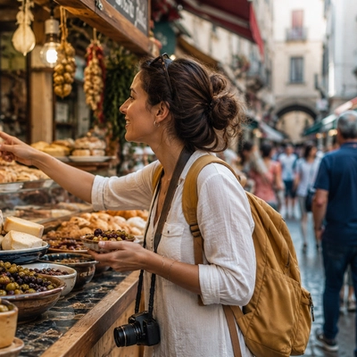
Some of the most interesting parts of a destination are not attractions at all. They are supermarkets, public transportation, residential streets, morning routines, local parks, bakeries, markets, and the way people gather in public spaces. A tourist can easily move through a city seeing only the places designed specifically for visitors. A traveler becomes curious about what happens between those places. That might mean taking a local bus instead of a sightseeing route, walking a few streets beyond the main square, visiting a neighborhood market, or simply watching how a city changes between morning and evening. None of this requires finding a secret location that nobody else knows about. It simply means noticing that a destination is somebody else’s everyday home, not a stage created for your holiday.
Travelers are willing to change their plans
Tourists often arrive with a clear idea of what the trip should look like. Travelers are more comfortable letting the destination change that idea. A restaurant owner might recommend a nearby village. Bad weather might make the planned beach day impossible. A neighborhood that looked unremarkable online might become your favorite part of the city. Being willing to change direction creates opportunities that cannot be planned months in advance. This does not mean avoiding reservations or refusing to make an itinerary. Good planning can make travel significantly easier. The difference is treating the itinerary as a framework rather than a contract. When every hour is fixed, unexpected discoveries become interruptions. When there is some flexibility, they can become the best part of the trip.
Travelers interact instead of only observing
Travel changes when you begin having small interactions with the people around you. You do not need to make local friends everywhere you go or force conversations with strangers. Even simple exchanges can make a destination feel more human. Ask someone what dish they recommend. Learn a few words in the local language. Talk to a shop owner, guide, driver, or person sitting beside you at a café when conversation happens naturally. More importantly, pay attention to local customs rather than expecting everything to work exactly as it does at home. Different meal times, quieter Sundays, unfamiliar etiquette, slower service, or different ideas about personal space are part of being somewhere else. A traveler approaches those differences with curiosity rather than immediately deciding that their own way is better.
Being a traveler does not mean avoiding tourist attractions
There is a strange pressure around modern travel to find places that are “off the beaten path constantly.” Sometimes this simply creates a new kind of tourism where everyone searches for the same supposedly hidden cafés, viewpoints, and neighborhoods. You do not earn extra points for skipping the Louvre or refusing to visit a beautiful old town because other tourists are there. Famous places can be extraordinary. The goal is not to avoid tourism but to avoid experiencing a destination only through tourism. Visit the landmark, take the photo, buy the souvenir if you want one. Then walk a little farther. Try something you did not research beforehand. Spend time somewhere that does not appear on a list of the city’s top ten attractions. A trip can comfortably include both.
The real difference is curiosity
Ultimately, the difference between a tourist and a traveler has less to do with luggage, destinations, budgets, or how many famous attractions appear on the itinerary. It comes down to curiosity. A tourist can visit a place primarily to confirm what they already know about it. A traveler wants to discover what they do not know yet. That means looking beyond the postcard version of a destination, allowing plans to change, noticing ordinary details, and remembering that the places we visit continue existing long after we leave. You can take the guided tour, photograph every landmark, and still travel with that mindset. The goal is not to prove that you are better at traveling than everyone else. It is simply to come home knowing something about the place that you could not have learned without actually being there.